In the rapidly evolving landscape of modern software development, AI coding agents have transitioned from experimental novelties to core operational tools. Their primary promise is undeniable: unprecedented speed. However, speed in isolation is a double-edged sword. When deployed without structured boundaries and strict engineering discipline, AI agents often generate technical debt faster than developers can review it.
“They’re fast. They skip everything else.”
— Andrej Karpathy, Former Tesla AI Director & OpenAI Co-founder
The Core Problem: Speed Without Structure
When prompted with complex engineering tasks, autonomous coding agents naturally exhibit behaviors that prioritize immediate code output over architectural soundness. Left unguided, agents systematically bypass essential software engineering phases:
- They Skip Clarification (Unverified Assumptions): Agents tend to execute on their initial interpretation of a prompt without checking boundary conditions or asking clarifying questions. Unverified assumptions silently compound into major architectural flaws.
- They Skip Architectural Design: Agents immediately jump into writing implementation code. Requirement gaps, edge cases, and interface mismatches surface mid-implementation rather than during a deliberate design phase.
- They Skip Verification (Test-Last Syndrome): Code is written first; test coverage is deferred or forgotten. Consequently, regressions and subtle logic bugs that automated unit tests would catch in 30 seconds escape into peer review.
- They Overcomplicate Solutions: Without explicit simplicity constraints, agents often generate bloated 1,000-line abstractions for problems requiring concise 100-line functions, touching unneeded modules across the repository.
The Cost: Delivering the wrong implementation – extremely fast.
The Solution Architecture: Behavioral & Workflow Layers
To harness the speed of AI agents while guaranteeing production quality, engineering teams must wrap agents in a two-tier governance framework:
A. The Behavioral Layer (Agent Mindset)
Based on Karpathy’s core operating principles, agents are configured via Markdown instruction files that enforce deliberate thinking habits before file modifications occur:
- Think Before Coding: Thoroughly analyze project context and dependency graphs prior to execution.
- Simplicity First: Avoid unnecessary abstractions; write the minimum code necessary to satisfy specs.
- Surgical Changes: Limit scope tightly. Modify only target files and preserve existing design patterns.
- Goal-Driven Execution: Measure progress against concrete validation gates, not lines written.
B. The Workflow Layer (Enforcement Pipeline)
Behavioral rules are complemented by rigid orchestration frameworks (such as obra/superpowers or addyosmani/agent-skills). These frameworks introduce hard quality gates: progression to code implementation is blocked until specifications and test suites are validated.
The 5-Phase Development Workflow
At Fantastic5 Technology, we enforce a structured 5-phase engineering lifecycle. Tools merely automate enforcement; the discipline lies within the workflow structure itself.
[Phase 1: DEFINE] ──► [Phase 2: PLAN] ──► [Phase 3: BUILD] ──► [Phase 4: REVIEW] ──► [Phase 5: SHIP]
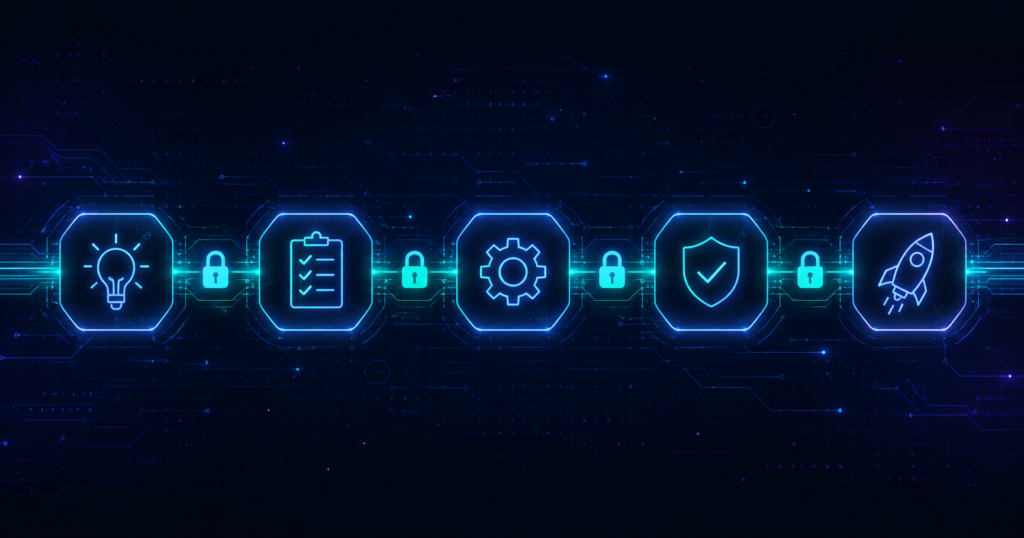
Phase 1: DEFINE – Establish the Specification
- Objective: Know exactly what you are building before writing a single line of code.
- Execution: The agent explores project context, asks clarifying questions one at a time, proposes 2–3 approaches with trade-offs, and presents design sections for human approval. A written specification document is committed to disk.
- Hard Gate: A written spec reviewed and approved by a human engineer.
Phase 2: PLAN – Decompose into Verifiable Slices
- Objective: Ensure every task has clear scope, acceptance criteria, dependencies, and verification steps.
- Quality Check:
- Bad Task: “Implement authentication”
- Good Task: “Add JWT validation to POST /api/login — returns 401 on invalid token”
- Hard Gate: Micro-tasks broken into independently verifiable units.
Phase 3: BUILD – Strict Test-Driven Development (TDD)
- The Iron Law: No production code without a failing test first.
- Cycle:
- RED: Write a failing test $\rightarrow$ Confirm it fails for the correct reason.
- GREEN: Write minimal production code $\rightarrow$ Verify all tests turn green.
- REFACTOR: Clean up code $\rightarrow$ Ensure tests remain green.
- Rule: Any code written prior to a failing test must be DELETED immediately.
- Hard Gate: Tests written and failing prior to feature implementation.
Phase 4: REVIEW – Evidence-Based Quality Assurance
- Motto: “Looks good to me” is not a review. Evidence is.
- 3-Point Verification:
- Spec Compliance Check: Does the code match the written spec?
- Code Quality Check: Correctness, test coverage, clarity, simplicity, and security.
- Reproduction Case: Re-run original failure scenarios with logs.
- Hard Gate: Confirmed spec compliance and testing evidence.
Phase 5: SHIP – Controlled Deployment
- Definition of Done:
- All tests are green.
- Git branch is clean with atomic commits.
- Code has been reviewed by a human engineer.
- Rollback plan exists (< 5 minutes execution).
- Hard Gate: Human engineer makes deliberate merge approval.
Ecosystem & Implementation Tooling
To adopt structured AI workflows in your development environment, several open-source (MIT licensed) tools provide seamless integration:
| Tool / Repository | Layer | Description & Best Use Case |
|---|---|---|
| Superpowers (obra/superpowers) | Workflow | 14 skills chaining automated phases with hard quality gates. Best for automated pipeline enforcement. |
| agent-skills (addyosmani/agent-skills) | Workflow | 23 skills accessible via slash commands. Best for granular, engineer-driven phase control. |
| Karpathy Guidelines | Behavioral | 4 core principles governing agent sessions to maintain code simplicity and surgical execution. |
| GitNexus (abhigyanpatwari/GitNexus) | Intelligence | 16 MCP tools indexing codebases into knowledge graphs for deep context comprehension. |
Conclusion
AI coding agents possess immense potential to accelerate engineering throughput. However, raw velocity without process discipline produces fragile software systems. By structuring AI interactions around explicit specifications, test-first execution, and rigorous quality gates, development teams can consistently ship high-integrity code at scale.
Looking to elevate your team’s software engineering standards and AI workflows? Contact us here.